


Small fluid lines can face surprisingly demanding conditions once they are routed through a vehicle’s engine compartment. Windscreen washer circuits, headlamp washer systems, and coolant reservoir overflow paths may encounter heat, vibration, chemical exposure, and, in some layouts, direct sunlight.
Flexibility for tight routing, along with dimensional stability and fluid compatibility over the service life, is required of an extrusion hose used in these applications. DEKUMA develops automotive tube extrusion technology for polymer tubing, providing a manufacturing context for the material and dimensional requirements associated with different vehicle fluid circuits.
Underbonnet Conditions Shape Material Selection
Temperature is rarely uniform beneath the bonnet. A washer line routed close to the engine or exhaust-side components may experience substantially higher temperatures than another section positioned near the front grille. Heat exposure can also occur in cycles, with repeated transitions between cold starts, normal operating temperature, vehicle shutdown, and subsequent heat soak.
Washer fluids introduce their own chemical considerations. Formulations can contain water, alcohols, surfactants, dyes, and other additives, with compositions varying according to climate and regional requirements. The hose material needs suitable resistance to the actual fluid rather than relying on general chemical-resistance classifications. Low-temperature flexibility also matters in markets where the vehicle may operate below freezing.
External routing creates a separate concern: ultraviolet exposure. A section passing through an exposed area can receive repeated UV radiation over years, while vibration and movement place additional mechanical stress on the same section. Nylon extrusion can produce accurately dimensioned polymer tubing for automotive applications, but the appropriate resin and formulation depend on the required flexibility, temperature range, fluid exposure, and environmental conditions.
Routing Determines Hose Construction
Space limitations often dictate the path of washer and overflow tubing. A hose may need to pass around brackets, reservoirs, body panels, wiring, or other components without creating excessive bending stress. Excessive curvature can restrict fluid flow, while insufficient flexibility can place additional force on connectors and attachment points.
Wall thickness is another design variable. Thin-wall tubing can reduce mass and improve flexibility, yet it may offer less resistance to crushing or external damage. A thicker construction may provide greater structural support but can make tight routing more difficult. The specification needs to balance these characteristics against the relatively modest pressure requirements found in many washer circuits.
Multilayer structures may also be considered when several properties need to coexist. One layer can provide mechanical strength while another contributes chemical resistance or barrier performance. The value of such construction depends on the actual service conditions; adding layers without a clear functional purpose can increase processing complexity without providing a meaningful advantage.
Production Accuracy Supports System Fit
Dimensional consistency matters even in low-pressure fluid circuits because automotive hoses commonly connect to molded reservoirs, pumps, nozzles, valves, and other standardized interfaces. Variations in diameter or wall thickness can affect assembly force, sealing behaviour, and retention. Consistent geometry also helps maintain predictable flow characteristics along long routing paths.
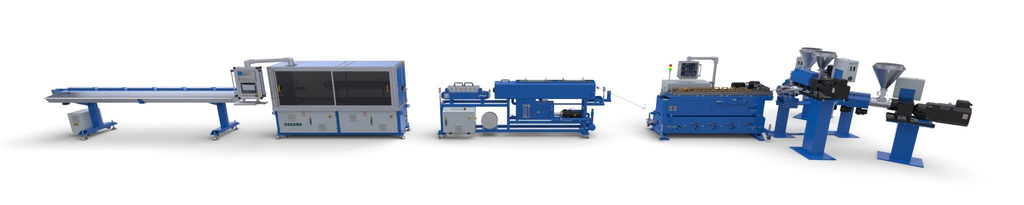
DEKUMA’s automotive pipe extrusion technology incorporates servo-controlled material feeding, specialized screw designs, and a multilayer composite die head for controlled layer formation. Its production lines can also integrate ultrasonic wall-thickness inspection and laser diameter measurement, together with servo-driven traction and cutting equipment. These features are relevant to automotive tubing production where dimensional repeatability is important, although the final machine configuration depends on the selected polymer and tube specification.
Process control extends beyond the extrusion die. Temperature regulation influences polymer viscosity, while stable traction affects finished dimensions after the material leaves the die. A touchscreen control system with modular temperature management can provide operators with process information during production. Quick die-head access can also simplify adjustments and routine maintenance when different tubing specifications are manufactured.
Washer Hoses Differ From Safety-Critical Lines
Not every automotive hose should be assessed against the same qualification framework. Washer tubing generally carries relatively low-pressure cleaning fluid, whereas brake and fuel circuits can involve significantly greater consequences if leakage or loss of function occurs. The distinction affects material requirements, validation depth, traceability, and applicable regulatory or OEM specifications.
Brake hose applications may require resistance to repeated pressure pulses, mechanical fatigue, fluid exposure, and severe environmental conditions. Fuel lines introduce additional concerns surrounding fuel permeability, chemical compatibility, emissions requirements, and long-term pressure behaviour. Washer systems usually prioritize reliable fluid delivery, low-temperature operation, flexibility, routing durability, and resistance to washer-fluid chemistry.
Coolant reservoir overflow tubing occupies another category. Although it may operate at modest pressure, proximity to hot coolant and engine components can produce a different thermal environment from a windscreen washer circuit. Nylon extrusion may be suitable for selected automotive tube constructions, but material selection should follow the specific fluid, temperature, pressure, flexibility, and environmental exposure defined for each system rather than treating all underbonnet tubing as interchangeable.
Conclusion
Automotive washer and reservoir tubing demonstrates why a relatively simple fluid path still requires careful engineering. The relevant specification can change substantially with routing position, fluid formulation, heat exposure, UV conditions, bend requirements, and connection design. Extrusion hose production provides a controlled method for creating tubing with defined dimensions and wall structures, while application-specific validation determines whether the resulting construction fits its intended duty.
DEKUMA‘s automotive extrusion technology combines controlled material feeding, multilayer die technology, dimensional inspection, and downstream servo equipment, giving manufacturers a production framework that can be adapted to different polymer tube requirements without treating washer lines, coolant overflow paths, brake hoses, and fuel systems as equivalent applications.

Dilawar Mughal is an accomplished author with a passion for storytelling. His works span various genres, from thrilling mysteries to heartfelt romance novels. With a keen eye for detail and a knack for character development, Sana Fatima weaves engaging narratives that captivate readers and transport them to new worlds.